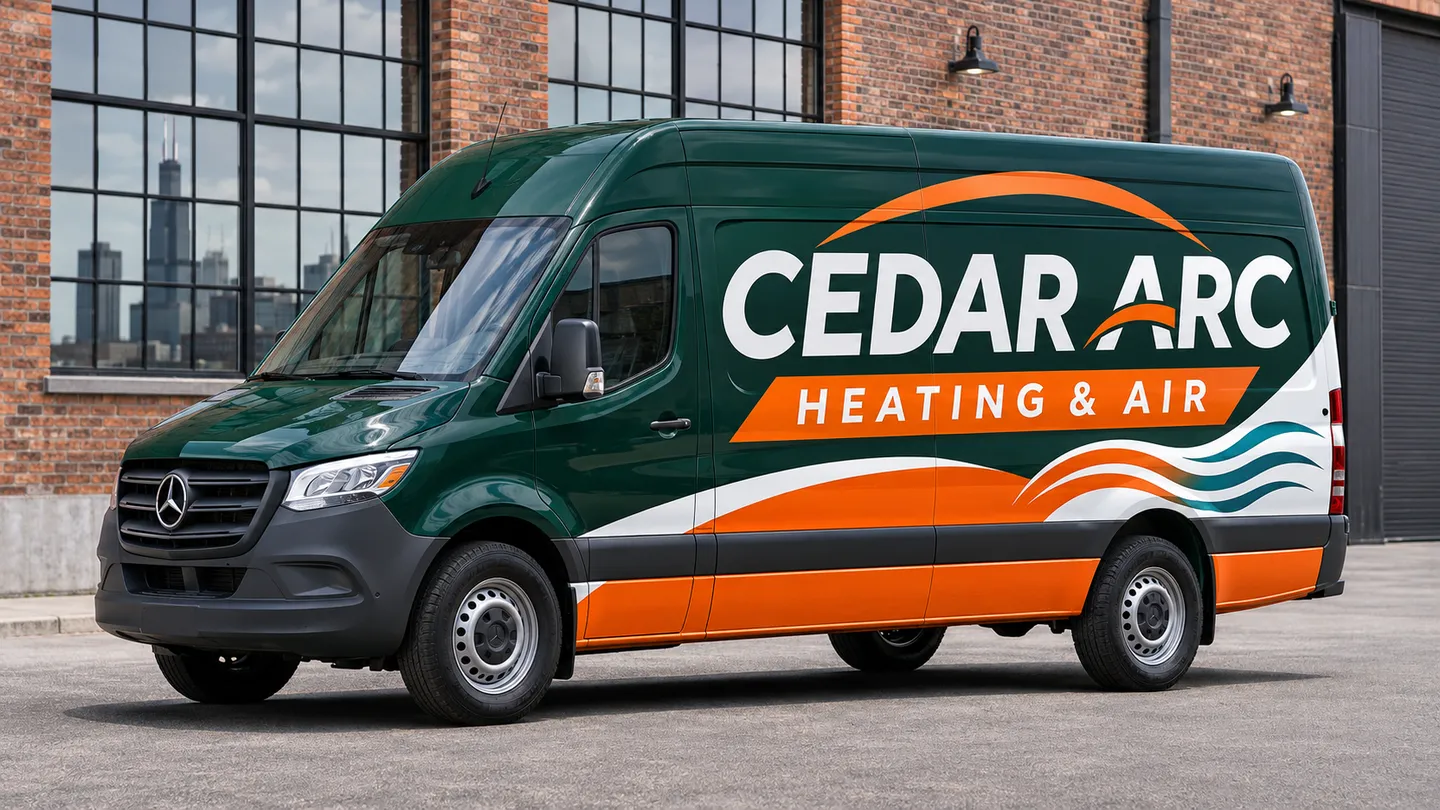
Give each view a job
Write the essential information for the passenger side, driver side and rear before judging the artwork. A service company may want its name and main trade recognized from the side, while the rear carries a clear contact route. Those are priorities to discuss, not a guarantee of reading distance. Mark what is essential in each view and what is optional. This prevents the largest uninterrupted panel from automatically absorbing every message in the brief.
- Check both sides independently when their doors or windows differ.
- Verify every supplied business name, contact detail and service description.
Show the interruptions at the right scale
Add current photographs to the proof review. Identify tracks, handles, window borders, vents, steps and equipment mounts with descriptive labels. An attractive digital image can conceal a handle that divides a phone number or a rack that blocks a logo. Ask the designer to explain the intended relationship rather than solving it through a guessed position. Separate a surface to be covered from equipment merely shown for context.
- Record removable accessories and who is responsible for handling them.
- Review the sliding door in the normal open position.
Approve boundaries as carefully as the artwork
Ask for a written list of included panels and exclusions. The visual concept and the production scope should agree about trim, glass, roof areas and returns. If the shop proposes a seam or a change of placement, review that decision before releasing production. After approval, preserve a copy containing the correct vehicle reference and revision. An updated slogan or corrected contact detail should trigger a new approval record rather than an informal note detached from the proof.
- Record accepted compromises where equipment limits usable space.
- Keep the final proof and coverage list together.
Keep a working record
Before you approve the next step
- Main message assigned to each useful view.
- Doors checked open and closed.
- Tracks, handles and equipment marked.
- Covered surfaces and exclusions written down.
- All wording checked against an approved master.
- Final body-specific proof revision retained.
Use the free planning tool to organize the details you can confirm and the questions still open.
Four questions before the next step
Does this review determine whether a surface can be wrapped?
It identifies the proposed surfaces and interruptions. The installer still needs to assess the actual substrate and select a suitable product and method. A proof is not a material compatibility approval.
Read the detailed guide: Review Sprinter graphics around doors and equipment
What if equipment will change after installation?
Describe the planned change before approving the design. Keep essential messages away from uncertain mounting areas where possible, and ask how replacement or reconfiguration would affect the approved coverage.
Read the detailed guide: Review Sprinter graphics around doors and equipment
Can a photograph confirm the wheelbase?
An overview helps reveal differences, but it should not be treated as a verified dimension. Use the vehicle documentation and a responsible measurement or inspection process to resolve the specification. Record who confirmed it.
Read the detailed guide: Identify the Sprinter before choosing a graphics template
Should every Sprinter have a separate record?
Keep an individual unit record even when several vehicles share a layout. Their equipment, previous repairs and condition may differ. A shared configuration reference can connect matching units without erasing individual exceptions.
Read the detailed guide: Identify the Sprinter before choosing a graphics template
Original technical sources
Use the linked publisher's current instructions for the exact product and vehicle. This planning guide does not replace its application, safety or warranty requirements.